By Alina Gorlova
Förord: Det här inte en typisk Militär Debatt-artikel. Den handlar inte om de militära aspekterna av krig. Den handlar om konst och motståndskraft. Den är inte skriven av en svensk militär, utan av en ukrainsk regissör. Varför publiceras den då här? Krig är inte bara en militär aktivitet. Det är hela folkets kamp. Trots det tenderar vi att låsa oss i de militära aspekterna av kriget. Denna artikel av Alina Gorlova handlar istället om nationens motståndskraft och förmåga att hålla ut. Det borde intressera även svenska militärer. För utan nationell motståndskraft är kriget redan förlorat.
/Redaktören
My call sign is Tarantino, second unit. Greetings from the heart of darkness.
Viktor Onysko, film editor. He joined the Ukrainian army at the beginning of the full-scale invasion, and was killed by Russians on December 30, 2022.
Although the question of creating art during war does not seem to be so problematic and not one that raises many controversial questions, the question of creating art during genocide, when the war that is being waged is existential, when the aggressor is trying to wipe out your nation, the question of creating art in such conditions becomes very problematic. In exploring this issue, I base my research on my own experience, the experience of my friends and colleagues, and the stories of Ukrainian artists who were killed by the Russians.
First, we need to remind ourselves what genocide actually is.
Raphael Lemkin coined the term genocide combining the Greek word γένος (genos, ”race, people”) with the Latin suffix -caedo (”act of killing”).
In the UN Convention on the Prevention and Punishment of the Crime of Genocide is noted:
In the present Convention, genocide means any of the following acts committed with intent to destroy, in whole or in part, a national, ethnical, racial or religious group, as such:
(a) Killing members of the group;
(b) Causing serious bodily or mental harm to members of the group;
(c) Deliberately inflicting on the group conditions of life calculated to bring about its physical destruction in whole or in part;
(d) Imposing measures intended to prevent births within the group;
(e) Forcibly transferring children of the group to another group.
Article II, 1948 United Nations Genocide Convention
On February 24, 2022, Russia invaded Ukraine to occupy our country, destroy our statehood, ban the Ukrainian language and Ukrainian art, steal our children, kill anyone who resists. The Russians have attacked to rape and kill our people, to destroy our mentality and to do everything possible to make us unable to live on, through physical or psychological trauma. There is no point in listing all the crimes committed by Russians in Ukraine. But is anyone surprised or shocked by the very sentence “Russian war crimes in Ukraine”? Or has this sentence joined the pantheon of other genocides that have already occurred in human history?
Living in 2024, we have no right to say that art can change anything in the world order. That art can stop a war or genocide. Then what is the point of an artist continuing to create when his nation, his country, is in mortal danger? When literally the entire population of the country has to mobilize in order to stay alive?
The passionate part of the Ukrainian artistic community that remained in Ukraine became a target for destruction done by the Russian state, as it was with The Executed Renaissance, when the Soviet authorities executed, sent to concentration camps, or drove Ukrainian artists and intellectuals to suicide for their pro-Ukrainian position and resistance to the totalitarian communist regime. It is impossible to establish the exact number of those killed, but some estimates put the number of repressed Ukrainian intellectuals at 30,000. So it should come as no surprise that you have heard so little about Ukrainian artists, but have heard so much about Russian artists.
Today, there are many Ukrainian artists who left their profession to serve in the army: actors, directors, painters, cinematographers, editors, poets, writers, etc. These people are convinced that now is not the time for art, that art can wait. Now the destiny of our country is being decided, and if we are wiped out, there will be no more art. There will be nothing to return to, nothing to make art about, except for endless reflection on suffering and tragedy, which will no longer make any sense.
In this context, I would like to mention Ukrainian writers Victoria Amelina and Volodymyr Vakulenko. Volodymyr Vakulenko was caught up in the Russian occupation in 2022 in the Kharkiv region. For his pro-Ukrainian position, Vakulenko was kidnapped by Russians, tortured and killed. His body was found in a mass grave in the forest under the number 319. During the occupation, Vakulenko wrote a diary in which he described everything he had witnessed. Before his arrest, he buried the diary in the garden of his house. After the Ukrainian army liberated the Kharkiv region, Ukrainian writer Viktoriia Amelina found it. Victoria Amelina was a very active and passionate writer and volunteer. Finding the diary of her murdered colleague was an important issue for her. As well as preserving Volodymyr Vakulenko’s name and memory
In the fall of 2023, Amelina was supposed to go to a writer’s residency in France to work on her book about Russian war crimes. But in the middle of the summer, a Russian missile targeted a cafe with many civilians. Victoria Amelina was among them. She died in hospital a few days later, on July 1, 2023. It was the birthday of Volodymyr Vakulenko, whose fate she cared about so much. I still can’t get this infernal coincidence out of my head.
Air-raid sirens across the country
“Sirens”, by Victoria Amelina
It feels like everyone is brought out
For execution
But only one person gets targeted
Usually the one at the edge
This time not you; all clear
The missile that killed Amelina and many other citizens was not stopped by words, movies, or paintings. The missile could have been stopped only by a similar missile fired from an air defense system. Of course, art serves cultural diplomacy very well, when you deliver the right messages, communicate problems through your works. But today we see that the world is so accustomed to images of suffering and war that it no longer shocks anyone. At the beginning of the 21st century, Susan Sontag outlined this problem, but in 20 years the world has become even more overwhelmed with images of suffering. The news from television has been supplemented by social media, where every war is shared with shocking content. Writing this essay in the spring of 2024, when over the past two years we have seen disturbing images not only from Ukraine but also from 7th of October in Israel and later Gaza. Pain, blood, and war have become part of the usual picture of the world, which is actually very honest.
Based on this, we can conclude that art is effective when there is a political will. And although many argue that culture is outside of politics, this is a hypocritical avoidance of the truth.
So, returning to the topic of the need to create art during war, I would like to note that many art projects currently being made in Ukraine serve as a documentation of events, which is extremely important for future research. Art as Documentation.
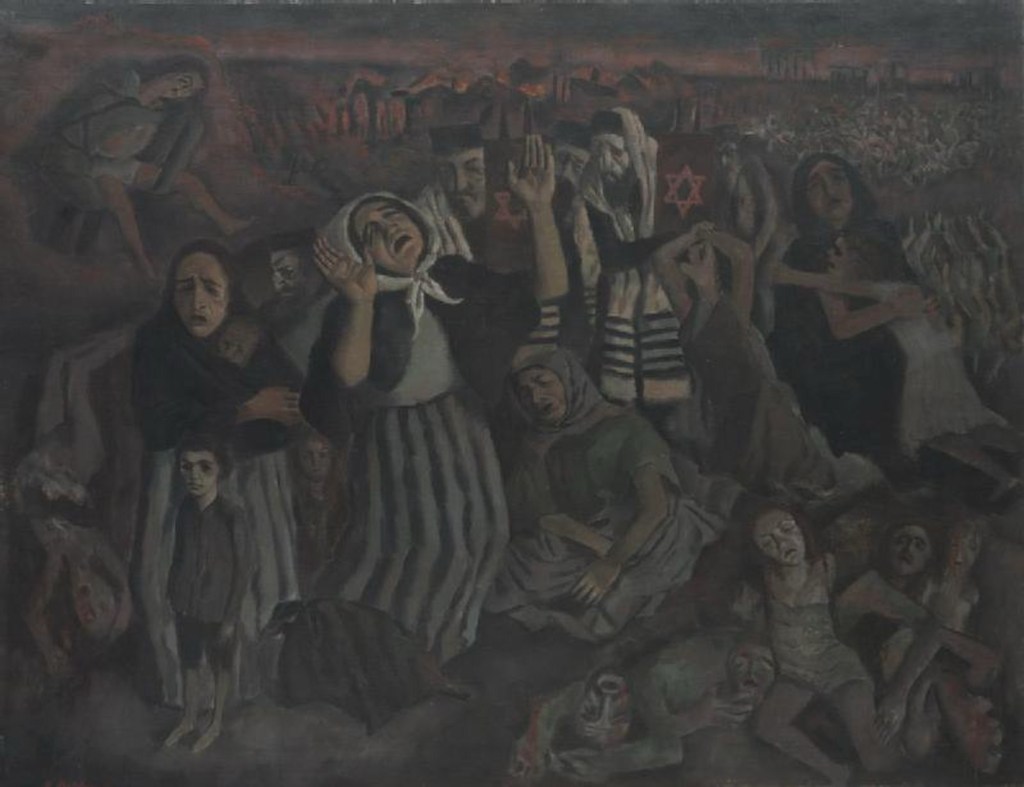
According to Pnina Rosenberg’s article ”Art During the Holocaust,” artists who were imprisoned in ghettos and camps had the opportunity to capture events that were not available for documentation in any other way. But it should also be noted that drawing could very often save the lives of artists. German camp staff often noticed the talent of Jewish artists, and painting provided an opportunity to get food.
Pnina Rosenberg writes in her article about Charlotte Buresova, a Jewish artist:
“Buresova mentioned that there were different points of view among the artists in Theresienstadt. While Jo Spier, a Dutch artist, believed that artists must paint even when cannons are firing, Buresova disagreed with him. She contended that there were times when she could no longer paint, but Spier urged her not to give in and to continue creating.”
In addition to the possibility of getting better living conditions, painting was also an opportunity for escapism from the terrible reality in which prisoners lived. This is why we can see flowers and food in the paintings of concentration camp inhabitants.
Talking to filmmakers from Myanmar, where the events are not so well covered by the media, I felt a common emotion of crisis within them as artists. Being lost, losing their sense of purpose, not understanding why they were making art. It was all painfully familiar to me. But they still continued to document what was happening. And one of the common motivations was ”to finish the movie so that I could feel better.”
In this context, I recall a phrase by Cambodian photographer and artist Vandy Rattana about his installation Bomb Ponds, which told about the traumas of his country’s past, namely the US bombing of Cambodia. He stated the purpose of his research as follows: ”I look for medicine to heal myself from the trauma of my history”.
The inability to create art is connected not only with the fact that Ukrainian artists consciously chose to go to the frontline, but also with the fact that some artists have suffered severe psychological trauma, which is why they simply cannot create art anymore. Only those who are not afraid to look into the eyes of death remain artists. I understand this as a need to reflect on traumatic experiences in art. Those who continue to create art in Ukraine are forced to talk about the war, forced to face the darkness. The ability to reflect events in artistic form forces them to reflect the terrible events of today. The artist is like a mirror.
And here I come to important questions:
What is the purpose of this act of creativity about mass graves, rape, murder, torture, captivity, and cities wiped off the map?
Will we be able to help anyone with our art or will we retraumatize people even more?
Will the art world change after this war, as it did after WW1 and WW2? Will Ukrainian art remain part of the cultural heritage of Europe?
Can we start to reconsider the role of the artist during the darkest times since WW2?
Alina Gorlova is a Ukrainian filmmaker, director, and screenwriter.
Efterord: Mängder av ukrainska artister, konstnärer och skådespelare tjänstgör nu vid fronten. Andra fortsätter att måla, fotografera och uppträda. Och Instagram, Spotify, konsthallar, husväggar, bokhandlar och utbrända ryska stridsvagnar fylls av konst och kultur. Det är ett av många sätt att kanalisera känslor och hantera kollektiva trauman. På så sätt upprätthålls motståndskraften i nationen. Även i Sverige sker ukrainska framträdanden och konstvisningar i små och stora sammanhang. Stöd dem! Besök evenemangen, köp böckerna, lyssna, titta och diskutera.
Just nu pågår utställningen Crossroads på Armémuseum i Stockholm. Det är en utställning om svensk-ukrainska kontakter under 1000 år. Den innehåller bland annat dokument, konstföremål och militär materiel, från vikingatiden till det pågående kriget.
/Redaktören

